
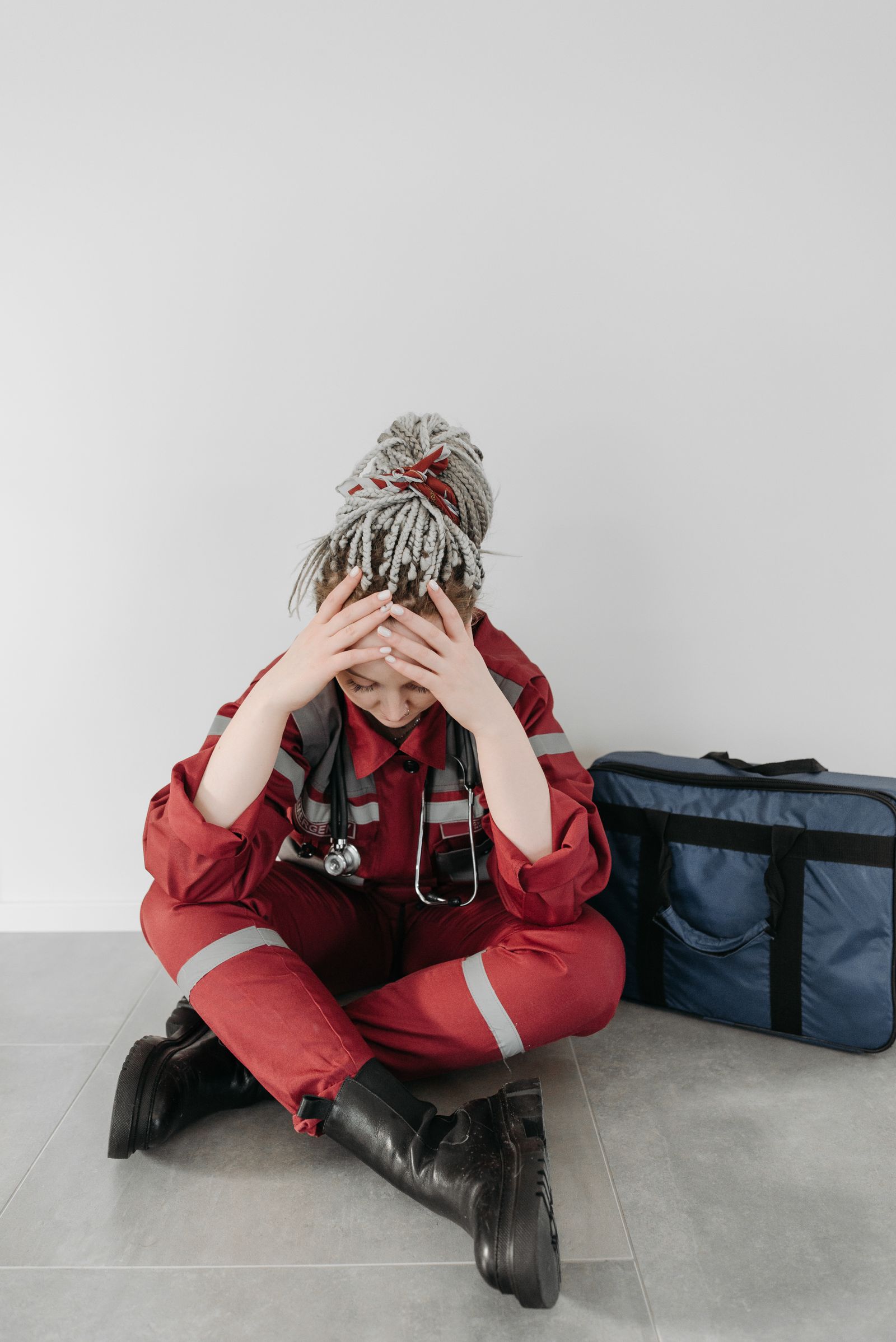
It's 2 a.m. and you're in the bathroom stall again — knees pulled to your chest, fourteen hours into a shift, dizzy because eating never made it onto the list. The unit is quiet enough now that you can hear yourself think, which is somehow worse than the noise.
Here is what nobody said out loud during those clinical rotations: the exhaustion is not a character flaw. It is a trained response. Somewhere between your first care plan and your first code, you learned that a good nurse is one who needs nothing — who skips the meal, holds the bladder, swallows the fear, and keeps moving. That lesson was never written on a syllabus. It didn't have to be. The culture taught it, the pace enforced it, and the praise you got for "having grit" locked it in.
Nursing school did not just teach you clinical skills. It trained you to disappear — to need nothing, skip the meal, swallow the fear, and call it dedication. That pattern has a name: the Silent Sacrifice Cycle. And it has an exit. This post names the cycle, shows what survival mode actually costs you, and lays out what reclaiming yourself requires.
This post is about that quiet training — the one that taught you to erase yourself in the name of the work — and what genuine nourishment actually requires once you decide to stop running on empty. Not rest as a reward. Something more structural than that.
The Training Was Never Just Clinical
Nursing school gives you pharmacology, pathophysiology, and the muscle memory to start an IV under pressure. It also gives you something you didn't sign up for: a set of rules about how much of yourself you're allowed to keep. The rules are simple. Your needs come last. Your body is a tool. Asking for help is a liability. Suffering quietly is professionalism.
You can see the damage before the career even starts. In the 2025 "Beyond the Bedside" survey conducted by Cross Country Healthcare with Florida Atlantic University's Christine E. Lynn College of Nursing, 67 percent of nursing students reported they were already worried about managing their workload — before their first real shift. That is not a workforce that hasn't learned the job yet. That is a workforce that has already absorbed the expectation of self-erasure and is bracing for it.
Name the source correctly and the shame starts to loosen. You did not arrive broken. You were shaped by a system that rewards disappearance and calls it dedication. Understanding that distinction is the first honest thing anyone will tell you about recovering from nurse survival mode — and it is where the real work begins.
What Survival Mode Actually Costs You
There's a name for the pattern you're living inside. The Silent Sacrifice Cycle, a framework from the Stronger Nurse Academy curriculum, describes the trauma loop nurses inherit and pass down: you're expected to endure the "trial by fire," and you're seen as weak if you name it out loud. Silence becomes the price of belonging.
The cycle moves in three stages. First, martyrdom — where exhaustion gets mistaken for excellence, and skipping lunch becomes proof you care. Then burnout — the emotional numbness and compassion fatigue that set in when the body stops being able to keep up with the performance. Finally, collapse — mistakes, illness, breakdowns, or the quiet exit from the profession entirely (Silent Sacrifice Cycle — Stronger Nurse Academy curriculum).
The data tracks the pattern. Sixty-five percent of nurses report high levels of stress and burnout, according to that same 2025 survey. And fewer than two-thirds — 60 percent — say they would choose nursing again if given the choice. Those numbers are not a story about weak individuals. They are a portrait of a system running on the fumes of people who were trained not to complain. The cost of survival mode is not only your energy. It is your relationship with the profession you once wanted badly enough to fight for.
Why the Exhaustion Feels Like Your Fault (It Isn't)
The cruelest part of the cycle is how personal it feels. You look around at nurses who seem steadier, faster, more certain, and you conclude the problem is you. That conclusion has a name too, and the curriculum built a tool specifically to interrupt it.
The Imposter Syndrome Reframe Card — Pocket Tool #1.3 in the Stronger Nurse Academy Phase 1 curriculum — is a wallet-sized, laminate-ready card designed to be pulled out in the exact moment the fraud feeling hits. One side names the triggers plainly: you don't know everything (you're a student — that's the role), you feel slow (most people do in the first months), you made a mistake (you caught it, you're safe). The other side holds five scripts to say to yourself on the floor, mid-shift, when there's no time for a pep talk.
What makes it more than a nice affirmation is the reframe underneath it: imposter syndrome is not evidence that you don't belong. It is evidence that you're taking the work seriously (Imposter Syndrome Reframe Card, PT1.3 — Stronger Nurse Academy curriculum). That's the shift from a vague sense of inadequacy to a specific, portable practice. The feeling doesn't vanish. But it stops being a verdict on your worth and becomes a signal you know how to answer.
The Silent Sacrifice Cycle convinces you that survival requires silence. But silence is what destroys us. The cycle can only be broken when you reclaim your worth, root in boundaries, and rise into freedom.
— Ashley Asberry, RN, BSN, Founder of Stronger Nurse
Reclaiming Isn't Rest — It's a Different Relationship With Your Worth

Most advice aimed at burned-out nurses stops at self-care: take a bath, use your PTO, buy the good coffee. None of that is wrong. All of it is insufficient. You can rest for a week and walk right back into the same cycle, because the cycle was never about a lack of sleep. It was about a belief that your value is measured by your output.
The Restored Pillar — the first of the Stronger Nurse Academy's five pillars — reframes recovery as reclaiming your wholeness rather than earning a break. Its practice is built on three plain truths a nurse repeats until they take root: I honor my story, and the burnout was real. I am healing, on my own timeline. My worth is not measured by my busyness (Restored Pillar — Stronger Nurse Academy curriculum).
Read those slowly. Not one of them asks you to do more. They ask you to reorganize what you believe about yourself before you add a single new habit. That is the difference between coping and reclaiming. Coping helps you survive the next shift. Reclaiming changes who you think you are when you walk into it — and that shift is what actually feeds a nurse back to herself.
The License Was Supposed to Be a Door, Not a Cage

Somewhere in the exhaustion, a lot of nurses quietly decide that this — the unit, the pace, the erasure — is what they signed up for, permanently. That belief is the cage. And it's worth naming directly: your license is a gateway, not a ceiling.
That RN credential is one of the most portable, leverageable licenses in healthcare. It opens into bedside, yes, but also into informatics, aesthetics, legal consulting, education, telehealth, travel, entrepreneurship, and a dozen paths most new nurses are never told about. The reason survival mode feels permanent is that it consumes the exact bandwidth you'd need to see the other doors. When you're in collapse, you can't strategize. You can only endure.
Reclaiming your worth is not a soft, feelings-only exercise. It is the precondition for strategy. A nurse who has stopped measuring herself by how much she can absorb is a nurse who can finally ask the strategic questions: What do I actually want the next stretch of this career to look like? Which door fits me? This is the heart of the broader work of nursing career clarity — and it isn't available to you until you climb out of the cycle first.
What Actually Feeds a Nurse Back to Herself
So what does genuine nourishment require? Not a bath. A different operating agreement with yourself — one where rest is not something you earn after collapse, boundaries are not a betrayal of your patients, and your needs are data worth acting on rather than weakness worth hiding.
The stakes here are not abstract. The national RN turnover rate rose to 17.6 percent in 2025, reversing a prior year of decline, according to the 2026 NSI National Health Care Retention Report (turnover ranged widely, from 5.6 to 40 percent depending on the facility). Every point of that number is a nurse the system pushed past the edge of enough. The profession keeps trying to solve this with sign-on bonuses. But you can't bonus your way out of a culture that trains people to disappear.
What feeds you back is not one grand decision. It's a structured, repeatable practice of reclaiming — naming the cycle, interrupting the imposter script, and rebuilding your sense of worth on something sturdier than how much you can endure. Strategic, not surviving. That is the work. And it is learnable, which means the exhaustion you're carrying was never the truest thing about you.
Frequently Asked Questions: Recovering From Nurse Survival Mode
How do I know if I'm in nurse survival mode?
Survival mode shows up as a pattern, not a bad day. Watch for chronically skipping meals and breaks, emotional numbness toward patients you used to connect with, dread before shifts, and a sense that asking for help would make you look incapable. If exhaustion has become your baseline rather than an occasional state, you're likely running the Silent Sacrifice Cycle — a trained response, not a personal failing.
Is burnout in new nurses normal, or a sign I chose the wrong career?
Widespread burnout is normal in the sense that it's common — 65 percent of nurses report high stress — but common is not the same as acceptable or inevitable. Feeling burned out does not mean you picked the wrong path. It usually means you were trained to run on self-erasure and no one gave you tools to interrupt it. The feeling is real. The verdict you're drawing from it may not be.
Can a nurse recover from burnout without leaving the profession?
Yes. Leaving is one valid option, but it is not the only path out of the cycle. Recovery starts with changing your relationship to your own worth — reclaiming wholeness before rebuilding strategy. Many nurses who feel trapped are actually in collapse, where every option looks impossible. Once you climb out of survival mode, you can evaluate whether to stay, shift specialties, or pursue a different path with a clear head.
What's the difference between self-care and actually reclaiming yourself as a nurse?
Self-care manages symptoms: rest, hydration, time off. Reclaiming changes the underlying belief that your value equals your output. You can practice self-care and still walk back into the same cycle, because the cycle was never about a lack of sleep. Reclaiming asks you to honor your story, heal on your own timeline, and stop measuring your worth by your busyness — the foundation self-care sits on top of.
Why do I feel like a fraud even when I'm doing my job well?
Imposter feelings tend to hit hardest exactly when you're growing — when patients ask questions you can't answer yet, or experienced nurses seem effortlessly confident. That feeling is not proof you don't belong. It's a sign you're taking the work seriously. The reframe that helps is specific: name the trigger, then answer it with a prepared script rather than spiraling into a story about your inadequacy.
Here is what has shifted, if you let it: the exhaustion you've been carrying was never a measure of your weakness or your fit for this work. It was the predictable result of training built to make you disappear. You are not a nurse who couldn't handle it. You are a nurse who was handed a cycle and never told it had an exit. Now you know it does.
Before you decide anything, find out where you stand.
The free career clarity self-assessment shows you where the Silent Sacrifice Cycle is costing you most — and which door your license opens next. It takes a few minutes, and it is built for nurses who are burned out, starting out, or starting over.
Ready to go deeper? Meet the Reclaim Yourself journal.
This post gave you language for what's been happening to you — the Silent Sacrifice Cycle, the imposter reframe, and the truth that reclaiming is about worth, not rest. That naming is real, and it's yours to keep. What a single article can't give you is the daily practice of rebuilding worth over time. You don't reason your way back to yourself once. You do it on the page, shift after shift, until the new belief holds.
The Reclaim Yourself journal is that structured daily practice — guided pages built on the Restored Pillar that walk you through honoring your story, interrupting the cycle, and reclaiming your worth on something sturdier than endurance. Reclaim. Root. Rise. This is where reclaiming stops being an idea and becomes a habit.
Before the journal, there's a free training that lays out the full framework explained — the Silent Sacrifice Cycle and the path out of survival mode — so you can see the whole map before you decide anything. Watch at your own pace.
Watch the free training → Stronger Nurse Academy free training
Continue Reading on StrongerNurse.com
If this named something you've been carrying, these three go deeper into reclaiming your footing:
Sources
- Cross Country Healthcare and Florida Atlantic University Christine E. Lynn College of Nursing. "Beyond the Bedside: The State of Nursing in 2025." Florida Atlantic University, 2025. https://www.fau.edu/newsdesk/articles/beyond-the-bedside-nursing-survey.php
- NSI Nursing Solutions, Inc. "2026 NSI National Health Care Retention & RN Staffing Report." NSI Nursing Solutions, 2026. https://www.nsinursingsolutions.com/documents/library/nsi_national_health_care_retention_report.pdf
Framework references, proprietary tools, and curriculum content cited in this post are drawn from the Stronger Nurse Academy curriculum. Ashley Asberry, RN, BSN, Founder.